2026.06.23 - 317 viewed
In the context of the fisheries sector's strong shift towards sustainability and value enhancement, the model of cultivating two-shelled clams (Tapes conspersus) linked to product consumption is showing great potential in Khanh Hoa. The recently organized training course on replicating this model has contributed to spreading technological advancements and expanding livelihood opportunities for coastal residents.
On April 14-15, 2026, the Khanh Hoa Provincial Agricultural Extension Center organized a training course to replicate a model under the National Agricultural Extension Project: “Building a model for commercial farming of clams (Tapes conspersus) linked to product consumption.”
Attending the training course were: Representatives from the Fisheries and Marine Affairs Sub-Department, the Provincial Agricultural Extension Center; representatives from the Public Service Centers of the communes/wards of Van Ninh, Nam Ninh Hoa, Cam Linh, and Cam Ranh; grassroots agricultural extension workers; and 30 trainees who are aquaculture farmers within and outside the model.
Speaking at the training course, a representative from the Provincial Agricultural Extension Center emphasized that developing new aquaculture species with high economic value, suitable to the natural conditions, is an important direction to increase people's income and develop a sustainable marine economy. Among them, the two-shelled clam is considered a potential aquaculture species due to its good adaptability, high survival rate, and stable market demand.
Mr. Phuong Minh Nam - Deputy Director of the Provincial Agricultural Extension Center, delivered the opening remarks.
Currently, the technical process for commercial farming of two-shelled clams has been recognized as a technical advancement by the General Department of Fisheries (Decision No. 115/QD-TCTS-KHCN&HTQT dated April 28, 2023), with basic indicators such as: Stocking density of 55–60 clams/cage (50 cm diameter, 27 cm height); survival rate of ≥75%; farming time of approximately 12 months; harvest size of ≥28 g/clam; yield of ≥1.5 kg/cage (equivalent to 7.5 kg/m²).
During the training course, participants were equipped with a general understanding of the biological characteristics of the two-shelled clam and received detailed guidance on the technical process of commercial farming according to recognized advanced techniques. The content included: preparing the farming area, designing and arranging cages, techniques for selecting and transporting broodstock, stocking methods, management and care, harvesting, and economic efficiency analysis.
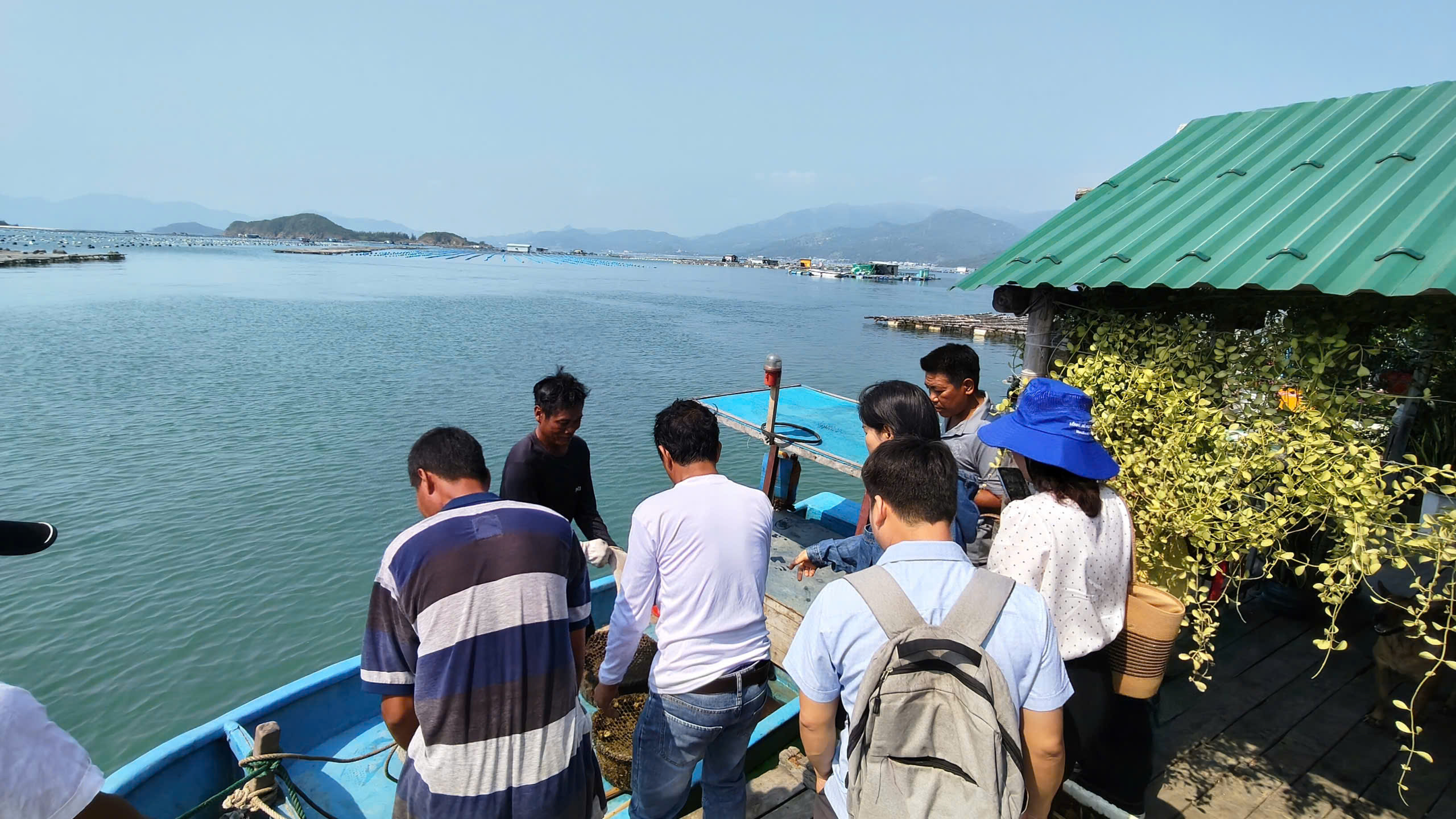
A highlight of the training course was the combination of theory and practice. Participants directly visited the farming model in the field, practiced technical operations such as cage preparation and stocking, and exchanged practical experiences with technical staff and farmers participating in the model.
Participants visited the project's implementation model in Nam Ninh Hoa commune.
The final assessment showed that 100% of participants mastered the technical process and were able to apply it to actual production. This is an important foundation for replicating the model, contributing to increased productivity, economic efficiency, and promoting sustainable aquaculture development in the locality.
Ha Thi Dung - Agricultural Extension Department